Tuesday, 20 September 2022

Antigone: The Musical

by Marina McCready

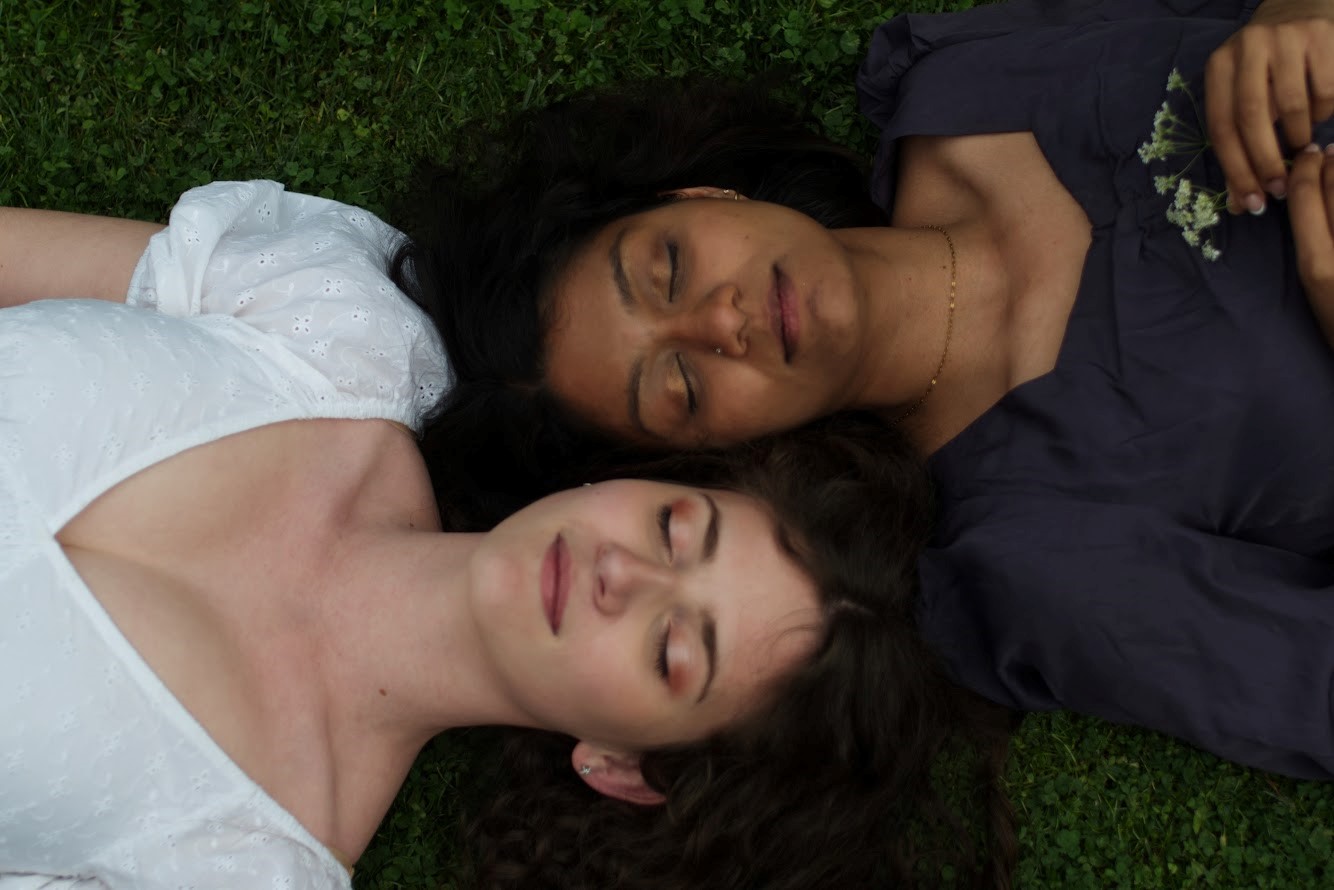
I first came across the Antigone story in a drama class in Year 9 and it stuck with me all the way to university, when I had an opportunity to study it again in my Classics degree.


When I decided I wanted to write a musical, I had a few different ideas, but none of them excited me as much as the idea of Antigone: The Musical. Antigone is such a strong, compelling character and her relationship with her sister really spoke to me. Parts of the play translated perfectly to musical theatre- the argument between Antigone and Ismene became a duet, as did the final confrontation between Antigone and Creon, whilst Haemon’s unrequited pining for Antigone seemed an obvious subject for a ballad.

That said, adapting it wasn’t the easiest. I quickly realised that I couldn’t end my first musical in a triple suicide. This was the point when I found out that Euripides had in fact written a version of Antigone in which Haemon saves the day. This version, combined with my own political leanings and experiences of protests, created a very new ending to the story featuring a people’s revolution- but you’ll have to watch the show to find out more!

Lots of people have said I’m ‘bold’ for adapting Antigone this way, but I’m not sure that’s entirely true. Classical literature has been subject to retellings and changes since its very beginning (I’m thinking of Sappho’s Homeric poems, or Vergil’s Aeneid). Antigone: The Musical is simply a successor to a long tradition of adaptation and transformation.


I’ve been so happy with the reactions to it in Edinburgh. I bumped into a group of 17 year-old girls and their teacher who had studied it recently and were very excited when I said I thought Antigone was a girlboss. The group left with a bunch of flyers, still chattering about their memories of studying the play and their opinions on the characters. I honestly don’t mind whether they actually see the show or not- I’m just glad to have prompted a conversation.

Antigone is clearly a story that resonates with many people- a young girl standing up to a tyrannical older man feels like it could have been written the 21st century AD just as much as the 5th century BC.


I’m sure I’ll get a few raised eyebrows for the changes I’ve made and it’s not going to be everyone’s cup of tea. But it’s fun, it’s a bit silly and it’s got heart. My hope with bringing this adaptation to Fringe is to reach audiences who might otherwise not want to watch a Greek tragedy, and to show that Classical stories can absolutely be enjoyable and relevant to our lives.

photo credits: Marina McCready

poster credit: Anna Piper-Thompson


Wednesday, 17 August 2022

The Classical Association Returns to Swansea

by Mai MusiƩ

In April 2022 the prestigious annual Classical Association conference took place at Swansea University. The conference was due to take place there in 2020, which would have been rather fitting as the University marked its centenary that year, but we all know what happened that year and in subsequent years. Despite the challenges of the global pandemic, which had a significant impact on our jobs and our well-being, the conference returned in full swing in 2022. I, like many others, was looking forward to catching up with old friends and making new ones, in real life! The advantage of the conference was that it offered a hybrid option; so those who were unable to travel for various reasons, including the dangers of the lingering virus, could also participate remotely. After all, if anything the pandemic has taught us it is the flexibility of technology to access lectures, attend virtual events and workshops, and to participate in panels with colleagues from across the globe on a number of topics without leaving the comfort of your home.


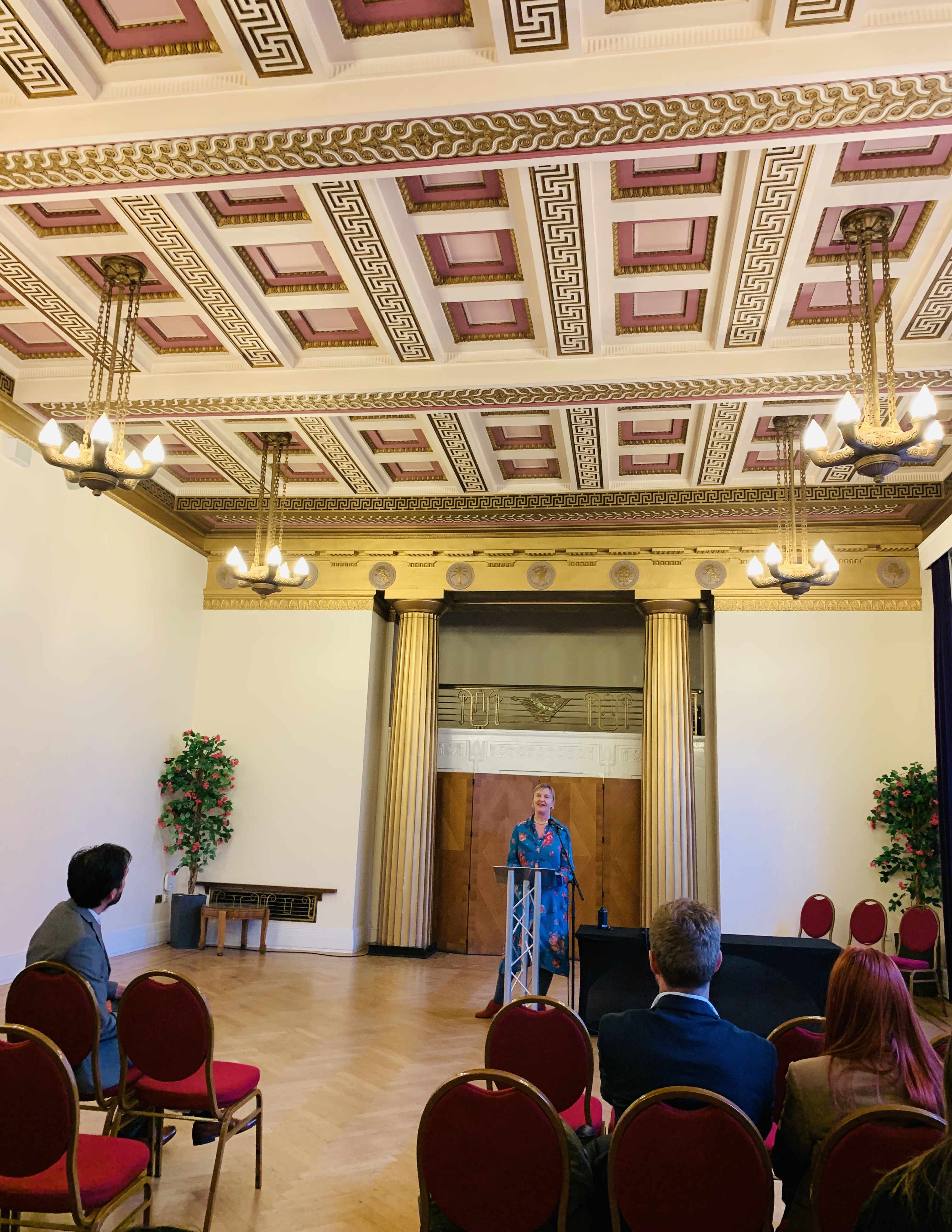
                                            A reading by Charlotte Higgins at the Guildhall complex

For me, the location of this year’s conference had a special significance. Swansea was my adopted home; I spent a large portion of my life studying and working there. I undertook all my degrees at the University, seeing the institution go through many changes, including the Classics department which used to be called Classics, Egyptology, and Ancient History and now has a new name – History, Heritage, and Classics. This shows the changing landscape of our disciplines in the 21st Century and perhaps shows the flexibility of our subject in that it can fit in and be comfortable with the humanities brand. Two days before the conference I found out that I was successful in an interview for a job based around public engagement and heritage – guess where? Swansea! It was a very sweet moment to realise that I would be returning to the department where it all began back in 1999, it felt rather Odyssean and had a lovely circular feel to my journey after spending 10 years in Oxford.

I was delighted too that the organisers of the conference wanted to continue the inclusive nature of these annual conferences, which for me was the highlight of the last CA conference that took place before the pandemic. At the 2019 FIEC/CA conference in London, I was fortunate enough to be part of not one but two panels which were ground-breaking in terms of their set-up: the plenary panel on the first day was an all-women affair, which looked at inclusivity and Classics. The second panel on the third day involved all-women from BAME background. Not to mention the various workshops on public engagement and outreach as well as pedagogy. In Swansea this year it was encouraging to see that the organisers wanted to continue the tradition of making the conference as inclusive as possible – both in the diversity of the papers and panels as well as accessibility.

I was lucky enough to chair a panel on Meroe and Nubia, which brought together Classicists and Medievalists looking at historical, archaeological, and literary approaches to the Northeast region of Africa. The academics presented their papers in a hybrid fashion (some were based in the US and Poland) so there was a sense that nobody was missing out because of travel/financial constraints. At this point I want to thank both Dr Ian Goh and Maria Oikonomou, the Swansea CA conference organisers, for making the time difference so bearable for our speakers! The other panel I was involved in was the Persia panel. It was such pleasure to be giving a paper alongside my former external examiner Prof. Lloyd Llewellyn-Jones, but the highlight has to be the added feature of our panel which included 'Persia on the Curriculum' led by three fantastic school teachers – Peter Wright (Head of Classics, Blackpool Sixth Form College), James Renshaw (Classics Teacher, Godolphin and Latymer School), and Anna McOmish (Head of History, Aldridge School). The fruitful discussion that followed amongst participants and attendees is possibly the reason why the annual Classical Association is so successful – that marrying up of university and school teaching and learning, a truly collaborative affair.

Other highlights of the conference included the inimitable Charlotte Higgins as she read an extract from her latest book ‘Greek Myths: A New Retelling’ in a rather fitting setting of the neo-classical and art-deco designed building the Guildhall complex (part of the offices of the City and County of Swansea Council). Of course, the biggest highlight of the annual conference is the conference dinner, and for obvious reasons this year had a special meaning to it. The setting – that neoclassical/art deco flair of the building, the classical music – led by Dr Ian Goh (who knew he was a professional violinist!), and of course the announcement of the CA Prizes. As the 2019 recipient of the CA Prize, I knew how special these prizes were and what it meant to the recipient. I was especially delighted to witness that this year’s winner was Dr Cora Beth Fraser who has taken Classics outreach to another level. You can find out more about Cora and her work here – you will have to agree that the CA couldn’t have found a more worthy winner!  

I wanted to conclude with a quote from another CA prize winner – this time from the Teaching category. L E Jenks-Brown’s experience of the CA conference this year, where she presented her first conference paper, really does capture the buzz and inclusive nature of the event: 

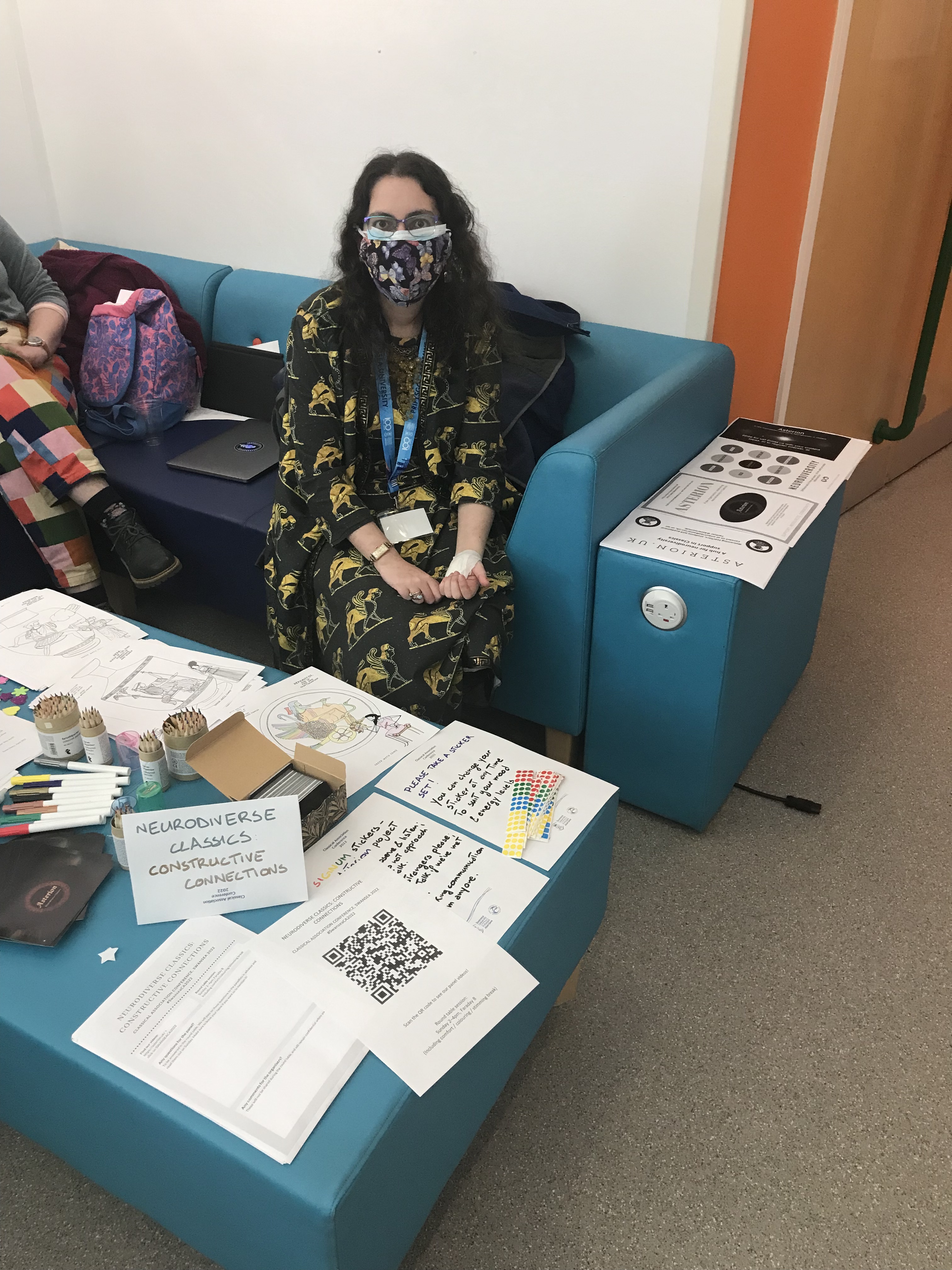
“It was a relief to be able to find quieter areas, such as the seating near the bookshops, and the Neurodiversity panel’s safe space near the main lecture theatre, to which to retreat.


The hybrid nature of the conference was also really interesting, as it enabled a lot more speakers as well as listeners to be in attendance. I found the lectures on physical objects and reception the most personally interesting. I loved the chance to handle objects from the museum, and the teaching-focussed pedagogical panels were extremely interesting and useful.


As I was staying with my husband and toddler outside of Swansea, I missed out on some of the social aspects of the conference, but the conference dinner with the presentations on the Sunday night was really exciting, and the whole conference was nice chance to catch-up with IRL (in real life) and Twitter friends.”


Dr Mai MusiĆ© is an Ancient Historian and Public Engagement Specialist, and is Public Engagement Officer for History, Heritage, and Classics at Swansea University

Email: m.musie@swansea.ac.uk ; maimusie@outlook.com

Website: drmaimusie.com

Twitter: @Dr_MaiMusie

Monday, 8 August 2022

The Interwoven Roots of Plants and Greek Myths

by Dr Lorna Robinson

Like many other people, the not-too-distant lockdowns created a space and stillness in my life which nature began to fill. From starting to recognise more of the little birds that visited our garden, to taking joy out of the vibrant orange and purple colours of the wildflowers growing in the verges of the nearby road, I grew to love things I had often not noticed before. 

It was from these long days, long walks, and quiet times, that the idea for a series of books called Telling Tales in Nature grew. Some of the myths I have always found most alluring have been those about the underworld, and so I decided to set the first little book in the series, Underworld Tales, there.


Stories, and in particular, myths, are a lot like plants, I think. They spring up often unexpectedly, they self-germinate, but with interesting variations, and before you know it, they are a flourishing ecology. And like nature, they are nourishing in a very deep way, providing wider and different perspectives, and new ways of looking at things. Stepping inside a myth is a lot like stepping inside a wood. It’s different each time, and you never know what you will find!


Increasingly, I bring nature into my teaching and lessons wherever I can for this reason. I find children and adults alike have a joy in knowing the different versions of stories, of hearing them over again, and seeing them in new ways. I find they take a similar pleasure in learning about plants of all kinds, so using stories which are interwoven with nature feels fitting. More than ever before, climate change calls for us to take a different approach to our lives and the nature around us, and I think that ancient ways of viewing plants and nature can help remind us of that interdependence and reliance that modern life can make us forget.


In the book, I start by introducing the plant itself, and giving some simple details about where it grows, what it looks like, and how people have used it in daily life. I then introduce the myth which is associated with the plant, before retelling the story from the perspective of the plant itself. In accordance with ancient Greek and Roman ideas about the spirits which inhabit different aspects of the natural world, I have imagined these spirits as nymphs. I finish with a new brief notes on ancient sources for the stories for those who want to explore further.


A talented young artist, Lydia Hall, who is based in Oxford, has created botanical illustrations for each of the plants, and also drawings of the characters and places imagined in the stories. Three of the myths are re-imaginings of ancient stories but in the case of Asphodel, I invented a completely new story for the plant, since one didn’t appear to exist. Lydia has created a mysterious, wistful, gently gloomy backdrop for all the stories, and she has drawn the characters with a careful eye for their view of the stories.


The plan is to create a series of these little books which explore lots of different plants and stories in different realms, from forests to gardens, and from seas to rivers. They are aimed loosely at ages 8+ to adult. I hope that they are simple enough for quite little ones to enjoy, and detailed enough for older children and adults, but I welcome all feedback on this first book, and am looking forward to seeing where it goes.


Contact Lorna by email at lro@cheneyschool.org

“Telling Tales in Nature: Underworld Tales” can be purchased as an e-book and paperback here.

All images: © Lydia Hall


Friday, 24 June 2022

CA 2022: Back Together By The Bay


Swansea University was the wonderful host of the 2022 CA Conference when hundreds (a classis of classicists?) flocked to the seaside to enjoy a weekend of papers, panels, pop-up discussions and plenty of long-overdue catching up over Welsh cakes in the Taliesin Centre.

Thanks to the tremendous organisation of Dr Ian Goh, Dr Maria Oikonomou and their brilliant team of Swansea staff and student helpers, the four-day programme ran smoothly and online audiences joined to watch from afar (bar a few technical difficulties). There was a real sense of community and camaraderie very gladly restored after more than two years of pandemic delays. 


On the opening evening, after a splendidly warm welcome from Professor Elwen Evans QC, Pro-Vice-Chancellor and Executive Dean for the faculty of Humanities and Social Sciences, we were treated to the premiere of a unique CA Presidential Address – a film, produced by Morphology Media, featuring 2021-22 President Stephen Fry in conversation with former CA Prize winner Professor Michael Scott. #FryandScott discussed Stephen’s long-held love for the ancient world, explored why Greek mythology is so timelessly engaging (as he captures in his trilogy Mythos, Heroes and Troy) and how ‘Classics is all around us’. Conference goers were delighted to see whom he would select if faced with ‘the Judgement of Stephen’ – just one of a range of entertaining questions posed by entrants to our Creative Writing Competition – and there was lots of audience participation in the quickfire round, with much deliberation over the best ancient fancy dress costume! You can watch some short clips as well as the full video on our YouTube Channel and Instagram.   


The Conference is a chance for academics, teachers and researchers, at all stages of their careers and interests, to present their latest findings about Classical topics, and to stimulate debate, discussion and knowledge exchange amongst the wider Classics community. Papers and panels ranged from the reception of Sappho to experimental archaeology, from Egypt in Latin Literature to Classics in sci-fi films, from ancient food to neurodiversity and from Aristophanes to teaching Achaemenid history. Indeed, there was a great array of pedagogy panels and teacher events across the programme and it was brilliant to also welcome colleagues from the UK’s leading Classical publishers and providers, EDI reps from across the country, handlers from The Egypt Centre, and our friends from Asterion and the new Classics For All Welsh hwb, as well as members of CA branches, CA colleagues, undergraduate students and many others to the Conference.


The evenings, too, were filled with Classical delights - with readings from a trio of brilliant writers, Emily Hauser, Jennifer Saint and Charlotte Higgins, which were followed by the presentation of our annual Teaching Awards at the Conference Banquet and announcement of the very worthy winner of the 2022 CA Prize, Dr Cora-Beth Fraser, and of our incoming President Professor M.M. McCabe.


The CA Conference is a prestigious event in the UK Classics calendar but scholars wear their intellect lightly; it was lovely to soak in the friendly, welcoming atmosphere and see such warmth, collaboration and inclusive debate – and there was even time for some seafood and sand with a stroll along the beach in the Swansea sun!


We look forward to welcoming you all to Cambridge University in April 2023. If you would like to find out more about presenting a paper, please click here.

Katrina Kelly, CA Engagement Coordinator 


Monday, 31 January 2022

Introducing Vocabulous

by Lucy Huelin

Vocabulous is an exciting new resource that aims to improve students’ English vocabulary by teaching Latin and Greek root word patterns in KS2/KS3 English lessons.

It is estimated that around 60% of English is derived from Latin or Greek, and in some fields, such as science or technology, this figure is closer to 90% [1]. And yet Latin is taught in just 2.7% of state schools (according to the British Council) and Greek in even fewer, so the strong patterns that pervade English vocabulary remain hidden to most.

Moreover, there is a significant “word gap” at transition from primary to secondary school; the Oxford Language Report estimates that 43% of Year 7 students don’t have the vocabulary they need to access their learning. Vocabulous aims to use Latin and Greek root word patterns to help tackle this “word gap”.

What is Vocabulous?


Vocabulous is a website for 11-year-olds, which teaches the Latin and Greek root word patterns that are the foundation of much of our English vocabulary, especially Tier 2 vocabulary that students use in all subject areas. The website is designed to be used in English lessons, so is suitable for all schools, and does not require teachers to have any knowledge of Latin or Greek!  

Vocabulous teaches students 35 root word patterns and over 1,000 English words, using a series of videos and quizzes. The first root students are taught is “port-”, which means “carry”. By making this root explicit and teaching its meaning, students are then able to understand words such as “portable”, “imported” and “deportation”, so learning the root pattern increases their vocabulary more quickly than if they were to just learn individual words.

There are ten levels, each set by an Olympic God or Goddess, and students can win badges and earn stars to climb their class' leader board.


When Year 7 students were asked what they like about the website, responses included:

·         “I like that you earn the Greek God badges when you complete levels.”

·         “I like how clear the videos are.”

·         “I think it is a fun way to learn the root words.”

·         “I like how you can see how your class is doing.”

·         “I like the pictures, especially Hades!”

·         “Everything. It’s in a simple and easy to understand format.”

Vocabulous has received funding from The SHINE Trust and is currently in the first year of a two-year trial programme. We are looking for schools to participate in the second year of the trial, with either Year 6 or Year 7 students. We would especially like to hear from schools with an above-average proportion of students receiving Pupil Premium. Please email info@vocabulous.co.uk if your school would like to take part.

To find out more about Vocabulous, follow @VocabulousUK on Twitter or go to www.vocabulous.co.uk.


[1] Green, T. M. (2008). The Greek and Latin roots of English (4th ed.). Lanham, MD: Rowman & Littlefield.


Friday, 17 December 2021

Fasti Online: Bulgaria


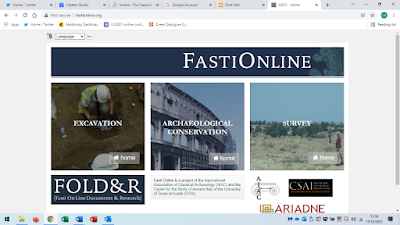
Like all the other national sites, Fasti Bulgaria, active since 2005, is jointly managed by AIAC and a national institution, in this case the Sofia University St. Kliment Ohridski. Currently, over 80% of the Bulgarian archaeologists are cooperating and over 1030 Bulgarian archaeological sites are published on Fasti Online, and each year 240 new bilingual excavation reports, both in English and in Bulgarian, are posted. Thus, almost all Bulgarian sites on Fasti Online have multiple excavation reports, many of them for the entire period from 2004 to 2018, without interruption. The Bulgarian sites that were published date from the Paleolithic, the Neolithic and the Chalcolithic periods, the Bronze Age, the Thracian period, the Roman Empire, the Byzantine Empire, the First and the Second Bulgarian Kingdoms and the Ottoman period, ranging from 1,600,000 BP to the 18th century.

In fact, Fasti Bulgaria was the second site that was launched after the Italian one and its success was a driving force and stimulus for other countries in Southeastern and Eastern Europe to subsequently join the project. Thus, since the Bulgarian sector on Fasti Online was up and running and became well known to the international audiences, Albania, Croatia, Kosovo, Moldova, Montenegro, North Macedonia, Romania, Serbia, Slovenia and Ukraine joined the project, while recently Greece also joined by integrating Archaeology in Greece Online with the Fasti platform.

The extraordinary wealth of sites under excavation in Bulgaria makes it an ideal example of the uses of the Fasti in the rapid internet dissemination of new archaeological research. A majority of the hits on the Bulgarian site come from Europe and the U.S., as it is now recognized by British, American and European scholars as by far the most important online academic resource in English on the ongoing exciting archaeological discoveries in Bulgaria. Fasti Bulgaria is a fine example of how the site can be used to promote Bulgaria's rich and important archaeology and, by making the results of Bulgaria’s heritage widely accessible and visible, to attract international visitors and develop the heritage tourism in the country. The site is permanently housed by the Institute for the Study of Ancient Italy at the University of Texas at Austin, and it owes its continued existence to a grant from the Classical Association, for which we are very grateful.  

Elizabeth Fentress, International Association for Classical Archaeology (Scientific Director of the Fasti Online project)

 Nikola Theodossiev, Sofia University St. Kliment Ohridski


Monday, 22 November 2021

Virtual Classics Conference organised by sixth formers

by Hebe Robertson and Lucy Turner, Oxford High School


On the 4th of November we hosted a virtual Classics conference, which we started planning in early September. This initially seemed like a daunting task, as we’re both Year 12 students at Oxford High School with no prior experience of running an event like this, however we quickly devised a plan. Our aim was to make it accessible to all ages and levels of experience, giving a glimpse of the Classical world beyond the curriculum and hopefully inspiring a love of Classics along the way.

The morning was dedicated to a series of workshops aimed at Years 7-9. We wanted to choose a theme for the workshops that would engage this age group, deciding on ‘The Gory Truth of the Classical World’. The two of us kicked off the day with a presentation on five ‘Evil Emperors of Rome’, complete with a quiz and fun facts drawn from the likes of Suetonius and Herodian. An incredible workshop on Roman Slavery by Dr Olivia Elder followed, in which she encouraged her audience to consider the variety of experiences of Roman slaves by looking at primary sources and drawing their own conclusions. Dr Alfonso Moreno then spoke on the (brutal) Athenian justice system and its punishments, pushing his audience to think about what we can learn from it, and the relationship between justice and democracy. 

Dr Alfonso Moreno

The timings for the afternoon were tight, as we had six fantastic speakers to fit in, but thankfully everything ran smoothly. Professor Oliver Taplin opened with ‘Are Greek tragedies necessarily misogynist?’ He discussed several critical interpretations of tragedy, using Antigone, Medea and Clytemnestra as examples. Professor Rosalind Thomas came next, with an engaging talk on ‘Memory and Historiography,’ which introduced the idea of collective memory, and how different narratives of certain events can come into conflict, including examples drawn from Thucydides’ History of the Peloponnesian War.

After that, we heard from Professor Phiroze Vasunia on ‘Classics and Colonialism’, an interesting overview of the influence of Classical architecture on the British colonisation of India. Using images of ‘classicised’ Indian buildings he expertly illustrated the far-reaching effects of Classics long after the fall of the Roman Empire. Dr Alison MacDonald next gave an illuminating talk on ‘Identity and Mobility in Roman Britain,’ using the archaeological record to prove that Roman Britain was incredibly diverse despite its portrayal in the media.


Our penultimate talk was from Professor Llewelyn Morgan, with the vivid title ‘Vile Violence in Virgil’. Though much of the Aeneid deals with violence, Professor Morgan looked at Aeneas’ actions in Book 12 and how some - for example human sacrifice - would be considered reprehensible even to the Romans. Last but certainly not least, we welcomed Dr Henriette van der Blom, speaking on ‘Roman Oratory - Where are the Women?’ She focussed on the rare occasions when women were compelled to speak in public - one notable example being Hortensia, who spoke against the imposition of a new tax on women.

Throughout the day, over 700 secondary school students and teachers from around the country attended online, while approximately 250 Oxford High School students attended in-house bringing the total audience to nearly 1000. We both learned so much while organising this conference, and although we were nervous at first, we enjoyed the day enormously. We wanted to reach as many people as we could and give them a different perspective on the study of Classics, and from the feedback we received it seems as though we reached that goal!


The organisers with a poster made by some Year 7 students


Thursday, 11 November 2021

Engaging Children with Classical Mythology: 'Once Upon a Myth'

by Athina Mitropoulos-Monk


Once Upon a Myth (Olympia Publishers, £9.99 $12.99) is a collection of five stories that blend fairy tales with Greek myths. Hansel and Gretel meet the Minotaur, Prometheus and Pandora climb the beanstalk, Penthiselea is merged with Cinderella, Little Red Riding Hood faces Dionysus, and Snow White is combined with Medusa. Each story is written in rhyming couplets which creates a fun mood to these newly imagined stories. For example, Prometheus, Pandora and the Beanstalks start like this:

In the mythical times, set long ago,

Things weren’t very bright, there wasn’t a glow.

No, our story starts in a cold and dark land,

Where all were under cruel Zeus’ command.

They serve as an introduction to Greek mythology and have a helpful, educational glossary at the back to support the learning of new characters and monsters. 

Having taught Classics for almost ten years, I know that personal interaction and activities are vital to promoting and inspiring an interest in the ancient world. I am therefore also running a series of workshops and talks at various schools and community centres to promote the book and mythology in general. A fee is asked when doing a series of workshops, however this is not applied to state schools or community centres. I have two types, though each is adapted to the given centre. Firstly, I have a Mythology Creative Writing workshop for years 7-9 where I discuss the appeal of mythology over the ages and how it is possible to retell one of these famous stories in a unique way, despite their popularity. Pupils are then encouraged to write their own version of a Greek or Roman myth. Secondly, I offer a Mythical Monsters workshop, aimed at years 4-6. This goes through a wide range of mythical monsters, from the well-known Medusa and Minotaur, to the lesser known Lamia and Chimaera. Pupils create top-trump style cards which are used for an activity and they are then encouraged to design their own mythical monster, inspired by the ones discussed. I am running these at state and private schools, as well as local community centres, and am very keen to continue offering these in the future.


From a recent workshop at Cranleigh Prep School, one pupil reported back that "the talk was excellent, and Mrs Mitropoulos-Monk was very inspiring.” 

Another parent posted “My son absolutely loved it! Thank you. We are reading it every night!”

If you are interested, please email me at athina.mitropoulos@gmail.com


Friday, 5 November 2021

An Ancient Greek Philosophy of Management Consulting

by David Shaw

My forthcoming book, “An Ancient Greek Philosophy of Management Consulting: Thinking Differently about its Assumptions, Principles and Practice”, explores the work of ancient Greek Philosophers from the end of the 6th century BCE to the end of the 4th century BCE, in a search for new perspectives on the management consulting industry. The publisher, Springer International Publishing, has announced details of the book at the following link: https://www.springer.com/gb/book/9783030909581. In his Foreword to the book, Andrew Pettigrew - Emeritus Professor of Strategy and Organisation, Said Business School, University of Oxford – speaks of "its capacity to shape the theory and practice of management consulting and the development of the scholarly field of management itself".

Management consultants’ practice is influenced substantially by the assumptions and principles that they bring to their work. Very often, these assumptions and principles have been adopted unconsciously, and in consequence have eluded serious, critical examination. The rapid growth of the management consulting industry has brought substantial change over time, both in its scope and scale and in its fundamental characteristics, and may have outpaced the capacity of management scholars and management consultants themselves properly to scrutinise the assumptions and principles that now underpin the industry. Important philosophical issues underlie these assumptions and principles. The nature of the organisations in which management consultants seek to facilitate strategic change, and of the interventions that they make in them, are ontological questions. The ways in which management consultants ought to behave in order to perform their work in a morally acceptable way are ethical questions. The nature of management consultancy knowledge, and whether management consultants actually possess the kind of knowledge to which they lay claim, are epistemological questions.

The ancient Greek philosophers thought deeply about these kinds of questions, but they approached them from a very different intellectual tradition from our own, and they were responding to social and economic conditions that were wholly unlike ours. The distinct perspectives that are reflected in their work provide a rich resource for novel thinking about contemporary philosophical questions, including those arising in so modern an industry as management consulting. The speculations of Heraclitus, Parmenides, Leucippus and Democritus about the nature of the universe have the power to stimulate useful new perspectives on the nature of organisations and management consultancy interventions in them. Aristotle’s development of virtue ethics has a distinct contribution to make to assessments of what constitutes ethical practice in the professions and in business, including management consulting. Plato’s theory of knowledge and belief, and Aristotle’s distinction between wisdom (sophia) and prudence (phronesis), are invaluable in assessing the kind of knowledge that management consultants need, and are capable of possessing.

The endeavour to acquire some depth of classical knowledge is, however, necessary in order to unlock the rich seams of useful novelty that lie embedded in the work of these ancient thinkers. Distinct, ancient religious beliefs run through much of the work of these philosophers. Thus, Heraclitus’s belief that much, if not everything, in the universe consisted of continually changing flows, like the flows of water in a river, rather than static substance, can properly be understood only in the context of his belief in divine Justice (dike), that is, the order of the universe that had been ordained by the gods, whereby there was continuity in the universe that enabled us, for example, to be assured that the sun would rise each morning and set each evening. Plato and Aristotle lived in the city-state of Athens, and their notions of what constituted moral behaviour could not be separated from their beliefs about the ways in which people ought to behave towards each other in this powerful, maritime state that was yet probably no more populous than the English city of Wolverhampton. Moreover, these philosophers revealed their ideas in language that often defies translation; for example, the usual translation of “virtue” only partially captures the sense of the Greek word arete as it appears in the work of Plato and Aristotle, and the shifting in meaning of the Greek word hamartia between a “missing of the mark” or a “mistake” to, in Christian texts, “sin”, makes Aristotle’s use of it complex and even debatable.

Management consultants’ rhetoric typically promotes the notion that they have methods that enable them reliably and predictably to bring about particular kinds of organisational change that their clients desire. Consideration of this rhetoric in the light of comparison with the speculations of the Presocratic philosophers, and with the ideas of Plato and Aristotle on knowledge and reasoning, suggests possibilities for different perspectives on the kinds of interventions that management consultants make and the nature of management consultancy knowledge.

Book retailers such as Amazon will announce the book in the near future.

October 2021

Dr David Shaw is an independent researcher on the philosophy of management, and a former Teaching Fellow at Queen Mary University of London and Visiting Lecturer at the University of Greenwich Business School.  David graduated with a degree in Classics from Oxford and spent 22 years as a management consultant, with UK-based and international experience in organisational change management. 


Thursday, 23 September 2021

CA Honorary President 2021-2022: Stephen Fry

 by Arlene Holmes-Henderson


We are absolutely delighted that Stephen Fry will be the Honorary President of the Classical Association in 2021-2022. A national treasure, Stephen is an English actor, screenwriter, author, playwright, journalist, poet, comedian, television presenter and film director.

Stephen is well known for his love of the ancient world. His bestselling trilogy of books Mythos, Heroes and Troy retell Greeks myths from theories of the world’s beginnings to the aftermath of the Trojan War. In 2019, he took these Greek myths on tour in a sold-out show around the UK via MythosLive: Gods.Heroes.Men.

Born in London, Stephen grew up in Norfolk and gained his A-Levels at City College, Norwich. He gained a scholarship to study at Queens' College, Cambridge but taught briefly at Cundall Manor, a preparatory school in North Yorkshire before taking up his place. Stephen has been a stalwart support of educators throughout his career: paying tribute to the world’s teachers during the Global Teacher Prize (2020) and sending a message of support to teachers in his home county via Radio Norfolk in January 2021. His book on poetic form, The Ode Less Travelled, is widely used in schools and colleges as a guide to prosody.

As a proudly out gay man, the award-winning Out There, documenting the lives of lesbian, bisexual gay and transgender people around the world is part of his thirty year advocacy of the rights of the LGBT community. Stephen’s most recent television role in 2021 was Tory MP Arthur Garrison in Russell T. Davies’s award-winning series for Channel 4, It’s A Sin.

He has been President of Mind, Britain’s largest mental health charity since 2011, and an honorary fellow of the Royal College of Psychiatrists for over ten years.

Stephen has won many prizes for his performances as an audiobook narrator – of his own works and most notably as the voice of J. K. Rowling’s Harry Potter books. Players of videogames may also recognise his voice: he is the narrator of the first four Harry Potter games as well as LittleBigPlanet, Fable II and Fable III.

We look forward to working with Stephen to engage all Classics enthusiasts in communities around the UK. Via our local branches, Teaching Board and annual conference, we will work together to showcase the breadth and diversity of ancient world studies while continuing to value and celebrate educators of Classical subjects at all levels.

Dr Arlene Holmes-Henderson is the Classical Association's Outreach Officer


Monday, 30 August 2021

Preparing for your first CA conference as a teacher

by Arlene Holmes-Henderson

On Monday 14th June 2021, the Classical Association (CA) hosted a virtual event for schoolteachers, designed to provide information, and dispel myths, about presenting at a CA conference as a teacher. Devised and hosted by the CA’s Outreach Officer, a former schoolteacher herself, the event was a successful example of collaboration and knowledge exchange across educational phases, with both academics and teachers presenting. 

The organisers of the forthcoming CA conference in Swansea 2022, Ian Goh and Maria Oikonomou gave a short presentation explaining the difference between a paper and a panel, outlining what makes a successful abstract and charting the process from abstract submission to conference presentation.

Three teachers then provided personal testimonies of their CA conference presentation (and attendance) experiences. Pete Wright (Blackpool Sixth), Gemma Williams (Allerton Grange School, Leeds) and Andrew Christie (Streatham and Clapham High School) explained which CA conference they had attended, what their paper title had been, how many people had been in the audience, whether they applied as a paper or as part of a panel, how they handled questions and whether the conference had been as expected.

In a Question and Answer session, Pete, Gemma and Andrew then answered questions such as: 

a)       What approach did each of you take to your ‘presenting style’? Did you read from a           prepared script, talk through powerpoint slides or something else?

b)      How did you handle questions from the audience?

c)       Tell us about your liaison with the panel chair.

d)      Did you produce a handout?

e)      How long did your presentation last?

f)        Did you get time off from your school to attend the conference?

g)       Did you pay to attend the conference, or was there some support available?

Pete, Gemma and Andrew ended by sharing their top three tips for aspiring teacher presenters. These included suggestions such as, ‘Go for it! You present information in an engaging way every day, why would 20 minutes at the CA be any different?’ and ‘Don’t try to cover too much – the time goes really quickly’. 

Ian and Maria ended the event by promoting Swansea’s tourist attractions – the conference is about more than just the academic papers - and making it clear that abstract submissions from teachers are especially welcome, with one whole theme dedicated to Pedagogy, Outreach and Technology. Other possible themes include Classics and the Future and Digital Classics.

Full details can be found on the Conference page of the CA website.

Because this event was the first of its kind, we were keen to gather feedback from participants. Results showed that 100% of attendees found the event ‘extremely useful’. 100% of attendees felt better informed about writing an abstract. 100% of attendees felt better informed about the difference between a panel and a paper. 100% of attendees said it was ‘likely’ that they would submit an abstract to the Swansea conference. When asked what they found most surprising, comments included: ‘how many people attend the CA conference’ and ‘that academics are keen for schoolteachers like us to get involved and have our say’.

The CA is the subject association for educators at all levels, and the conference is an important venue for bringing them into conversation.

The event was recorded and can be watched here (the playlist includes five videos of different sections of the event).

Dr Arlene Holmes-Henderson is the Classical Association's Outreach Officer


Wednesday, 21 July 2021

Two CA Officers contribute to volume on Classics Education

By Alex McAuley

In what must be a first for the Classical Association, two CA Officers, Arlene Holmes-Henderson and Alex McAuley, have each published a contribution to the volume Our Mythical Education, edited by Lisa Maurice.

The volume is part of the ERC-funded Our Mythical Childhood project, and examines the reception and use of ancient myths in formal education in the twentieth and twenty-first centuries across a wide variety of geographical case studies.

Arlene Holmes-Henderson’s chapter ‘Developing Multiliteracies through Classical Mythology in British Classrooms’ examines how creative and innovative teaching of classical mythology can act as a medium through which to enhance literacy. Two case studies from British primary and secondary schools demonstrate how the study of mythology contributes to pupils’ information literacy, cultural literacy and critical literacy skills.

Alex McAuley’s contribution, ‘Reconciling Catholicism with the Classics: Mythology in French Canadian Catholic Education’ considers the tension between the teaching of mythology and religion in Catholic schools in French Canada, and examines how the teaching of pre-Christian Graeco-Roman mythology fit into evolving narratives of French Canadian identity.

The volume has recently been published by the University of Warsaw Press, and is available to download open-access via this link. This research project will also soon be publishing the OurMythical Education Database, which will collate information and resources on the teaching of Classical Mythology for educators and the general public.

Alex McAuley is a Senior Lecturer in Hellenistic History at Cardiff University